

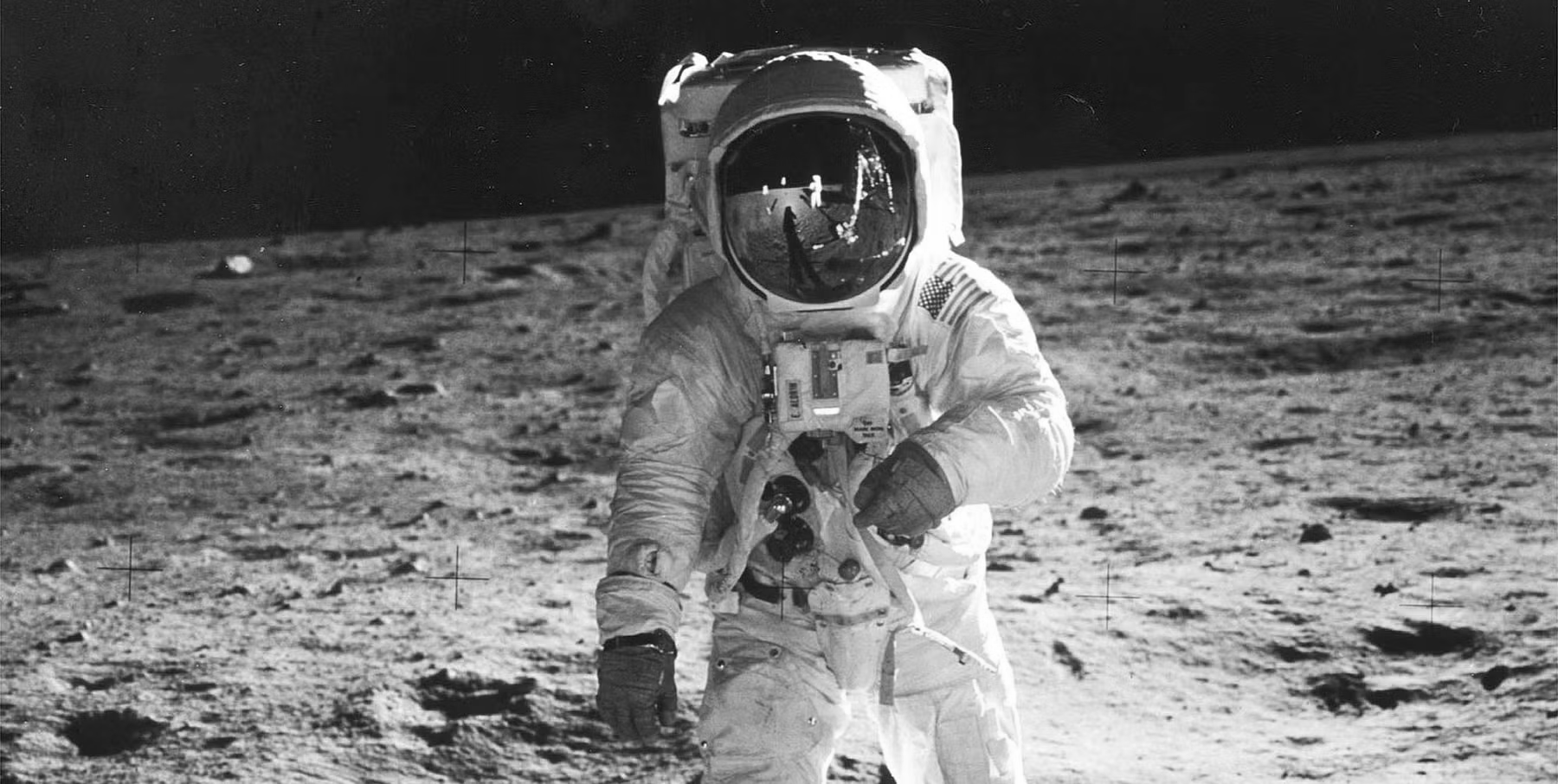
A lot of people wonder the same thing: “Why spend billions going to the Moon when people on Earth are struggling?”
It’s a fair question — and the real answer is more complicated than it looks. Here’s the teen‑friendly breakdown.
NASA’s Budget Isn’t What Most People Think
NASA sounds huge, but in the U.S. federal budget, it’s actually tiny.
- NASA usually gets less than 1% of the national budget.
- Even during the Apollo era, it peaked around 4% — and that was only for a few years.
In other words: NASA couldn’t solve world hunger even if it gave away every dollar it had.
World hunger, homelessness, and global crises require trillions, not billions.
The Moon Mission Was About Technology, Not Tourism
The Apollo program wasn’t just “let’s go touch some rocks.” It was a massive push to:
- develop new technologies
- advance engineering
- improve computing
- understand physics and materials
- push the limits of what humans can do
A lot of everyday tech exists because of space exploration:
- GPS
- satellite weather forecasting
- medical imaging
- water purification systems
- advanced materials
- computer microchips
The Moon mission accelerated decades of innovation in just a few years.
Space Exploration Helps Earth Problems — Indirectly but Powerfully
NASA’s work has helped with:
- climate monitoring
- natural disaster prediction
- wildfire tracking
- crop health analysis
- clean‑water technology
- renewable energy research
So even though NASA isn’t a hunger‑relief agency, its science helps the people who are fighting those battles.
The Moon Race Was Also About Global Power
Historically, the Moon mission happened during the Cold War. The U.S. and the Soviet Union were competing to prove who had better technology, stronger science, and could lead the future.
Space was the “high ground.” Winning the Moon race wasn’t just symbolic — it shaped global influence, alliances, and technological leadership for decades.
NASA Money Doesn’t Get Launched Into Space — It Stays on Earth
This is something people often misunderstand.
NASA doesn’t put money on rockets. NASA pays:
- engineers
- scientists
- construction workers
- universities
- private companies
- manufacturers
- suppliers
The money circulates inside the economy. It creates jobs, industries, and long‑term economic growth.
Solving Hunger Isn’t Just About Money
Experts agree that world hunger is caused by political instability, war, supply chain issues, corruption, food waste, lack of infrastructure, and climate disasters, among others.
Even if you dropped billions of dollars on the problem overnight, it wouldn’t magically fix the systems causing it.
Hunger relief is constant, not a one‑time fix. Even when charities help, the need never stops.
Food runs out. Wars continue. Droughts return. Refugee camps grow. Supply chains break again. So they need continuous funding — not a one‑time donation.
Imagine choosing not to invest in the future of humanity just to cover a few meals for all the poor people in the world.
Then, why homelessness can’t be fix instead of hunger
Well, housing isn’t a “Simple Fix,” even if it looks like one.
At first glance, homelessness feels like the kind of problem money should be able to solve quickly. Hunger requires constant resources, but housing looks like a one‑time investment: build a home, give someone a place to live, and the crisis should disappear. But the reality is far more complicated, and the reasons homelessness persists have less to do with charity and more to do with how society, cities, and systems actually work.
The first thing to understand is that homelessness isn’t just about lacking a roof. For many people, it’s tied to deeper issues like mental health struggles, addiction, trauma, medical debt, unemployment, or escaping unsafe situations. A house helps, but it doesn’t magically fix the circumstances that pushed someone onto the street in the first place. Without long‑term support, many people end up cycling back into homelessness even after receiving temporary housing.
Then there’s the cost. Building affordable housing in the United States is shockingly expensive. A single unit can cost hundreds of thousands of dollars once you factor in land prices, construction, safety codes, labor, and city regulations. It’s not as simple as “just build cheaper houses.” Cities require buildings to meet strict standards, and land in urban areas — where homelessness is most visible — is extremely costly. Even when funding exists, projects can take years to complete.
And that’s assuming the project gets approved at all. Many neighborhoods fight against shelters or affordable housing developments because they fear lower property values or increased crime. This “not in my backyard” attitude slows or blocks construction, even when the city wants to move forward. So the issue isn’t just money — it’s politics, zoning laws, and community resistance.
Another layer is that homelessness requires more than a building. People need mental‑health services, addiction treatment, job training, medical care, and case managers who help them stay stable. Without that support, housing alone doesn’t last. Programs that combine housing with services work well, but they cost more and require long‑term funding, not one‑time donations.
It’s also important to understand that government budgets don’t work like personal budgets. Money isn’t sitting in one big pot waiting to be reassigned. Housing programs compete with dozens of other priorities — healthcare, education, transportation, defense, emergency response — and they often lose out. Even if NASA shut down tomorrow, its budget wouldn’t automatically shift to homelessness. Government spending doesn’t transfer that way.
The biggest driver of homelessness today is actually the housing market itself. Rent has risen much faster than wages in many cities, and when people fall behind, they get evicted. Once someone loses housing, it becomes incredibly hard to climb back without support. This is why homelessness is rising fastest in places with high rent, low vacancy, and strict zoning laws. It’s not a charity problem — it’s an economic one.
So why do charities still ask regular people for donations? Because they can’t change zoning laws, regulate rent, or force governments to build housing. They can only provide immediate help: shelters, temporary housing, food, hygiene supplies, and emergency support. They rely on donations because they don’t control national budgets, and because the people who donate — even those struggling themselves — are often the ones who care enough to act.
Homelessness looks simple from the outside, but it’s actually a web of economic, political, and personal factors. A house helps, but it doesn’t fix the system that creates homelessness in the first place. Donations don’t solve the root causes — they help people survive while the system slowly tries to catch up.
Why the Moon First? Because It Opened the Door to Everything Else
Going to the Moon:
- pushed human knowledge forward
- created new industries
- inspired generations of scientists
- expanded global cooperation
- built the foundation for satellites, GPS, and modern communication
- proved what humanity is capable of when it works together
It wasn’t “Moon instead of Earth.” It was “Moon so we can understand Earth — and the future — better.”
The moon is the first step to prepare for future missions to Mars, enabling the survival of the human species off Earth, rather than only addressing immediate crises.
Summary
NASA didn’t choose the Moon over world hunger. NASA and hunger‑relief organizations have completely different missions, budgets, and tools.
The Moon mission:
- cost far less than people assume
- created tech we use every day
- boosted the economy
- advanced science
- helped Earth indirectly
- happened during a global power race
- inspired innovation for decades
And most importantly:
NASA’s budget is too small to solve world hunger or housing for the homeless — but its discoveries help the people who can.
Leave a Reply